


Union vs Stone Spark splitboard bindings: which one is right for you?

Founder of Stone Snowboards

A splitboard binding isn’t just a bit of plastic that holds your boots in place. It’s what connects your legs to your board. It’s the thing that can make you love or hate the climb, and turn your descent into pure joy or a real slog. So, Union bindings or Spark bindings? At Stone, we stock both, and we’ve taken the time to test and compare them. Let us explain: Union vs Spark – which ones are right for you?
First off, why are splitboard bindings so important?
When we talk about splitboards, we immediately think of the board that splits in two, the climbing skins, the avalanche transceiver… But splitboard bindings are often the link we underestimate. And yet, they’re what hold your feet in place, transmit your power, and help you climb and descend without wrecking your knees.
It’s a bit like boots for a hiker: if they’re the wrong choice, you’ll struggle the whole way. A good pair of splitboard bindings gives you:
-
Responsiveness on the descent
-
Efficient switch between ascent and descent
-
Comfort on long approach walks
So no, they’re not “just an accessory”. They’re the heart of your riding system, the part that will make your day smooth… or a struggle.

Union bindings and Spark bindings: two visions of splitboarding
Union bindings: Italian-style comfort!
At Union, they don’t mess about. The brand has its roots in classic snowboarding and it shows: everything is designed with the descent in mind. When they ventured into splitboarding, they kept that ride-first DNA. The result? Sturdy splitboard bindings that are easy to get to grips with, and offer the same level of comfort as classic bindings.
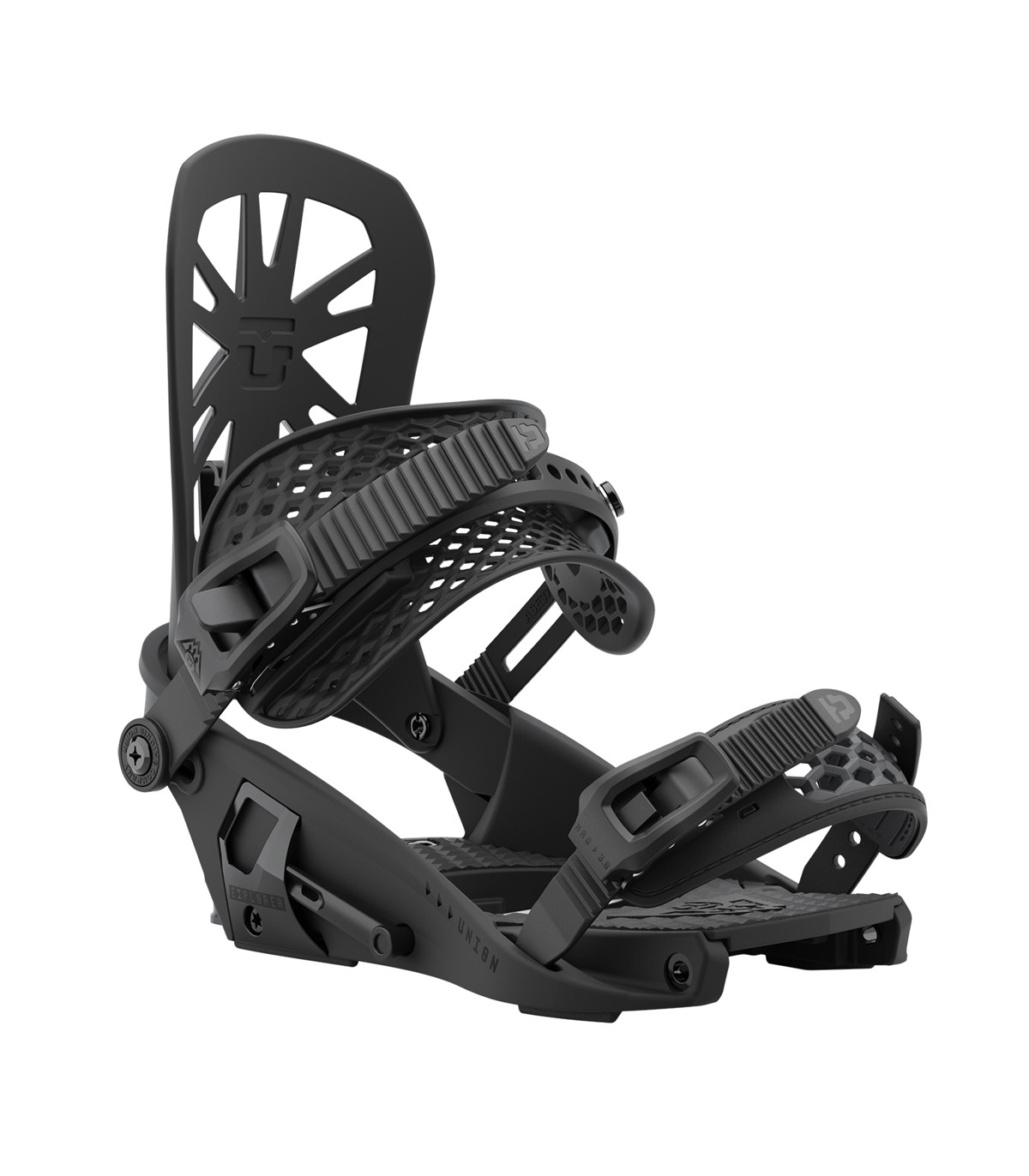
At Stone, we offer one Union model designed for splitboarding, with genuine expertise drawn from traditional snowboarding: the Explorer.
The Explorer (€389 on its own, €349 as part of a splitboard pack at Stone) is a simple, reliable and effective binding. Its profile is clearly all-mountain oriented, offering good performance with a slight nod to freestyle. It features an SP2 base in Duraflex CB, comfortable straps (Exoframe 2.0), an extruded aluminium heel cup and a thermoformed EVA bushing system. It’s the kind of binding where you forget you’re on a splitboard: smooth transitions, good support on the descent, and no unnecessary parts.
Stone Spark bindings: the expertise of a pioneer
Spark are the guys from Montana who’ve been tinkering away in their garage ever since splitboards first came about. But mind you, this isn’t just tinkering: it’s engineering. Their splitboard bindings are precision gear. Lightweight. Technical. Effective. What an incredible limited edition!
Stone is the first small brand to release splitboard bindings with Spark! We’re proud of that!
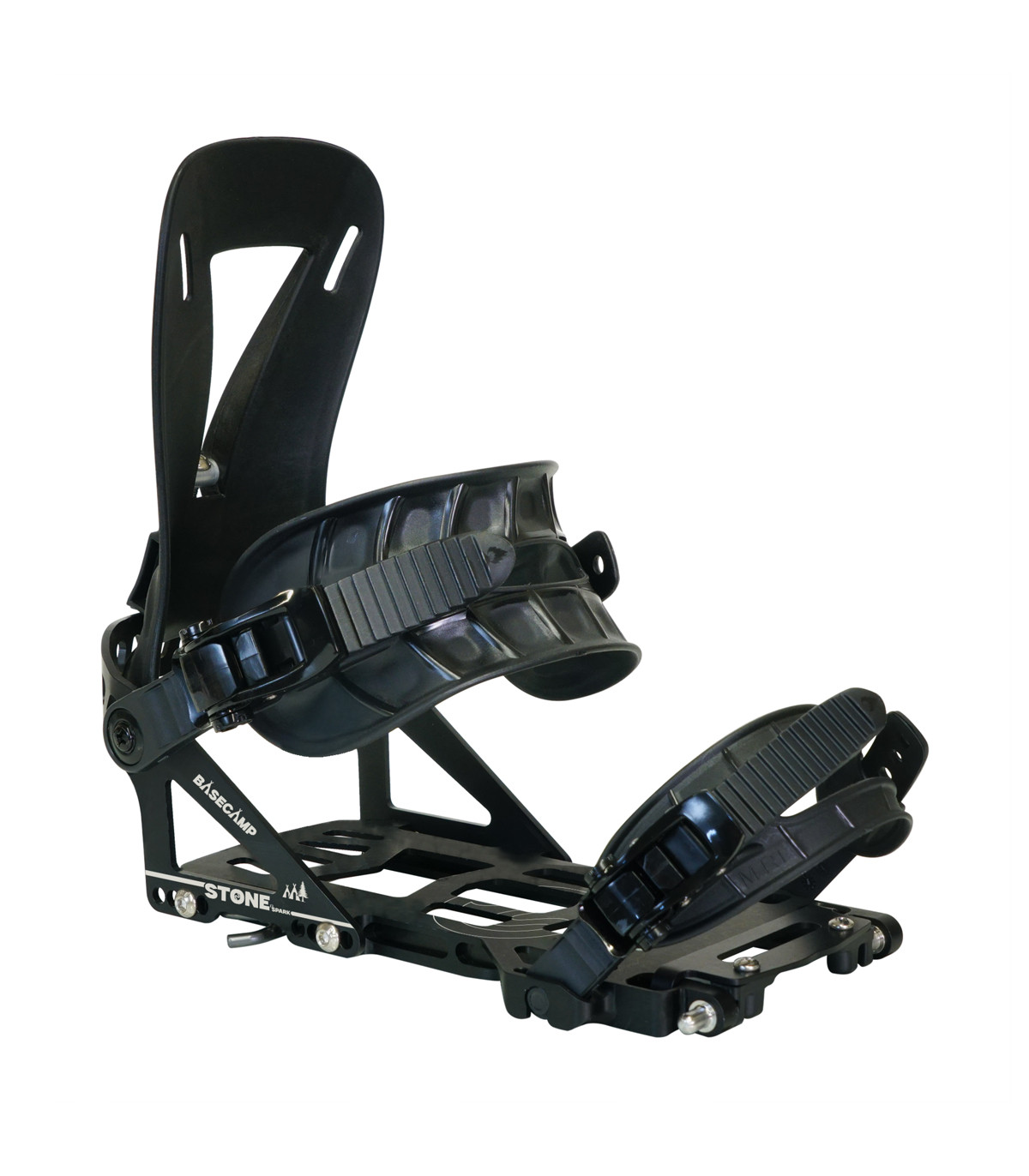
The Stone Basecamp x Spark (€549 on its own, or €648 with the Puck Set) perfectly embodies this philosophy. It’s ultra-light (628g per foot in size M), precise, responsive and built to last. Every component is optimised:
-
Asym Rip ’N’ Flip highbacks with medium flex, ergonomically shaped for left and right, featuring a tool-free FLAD system to switch from climb mode to ride mode.
-
Minimalist yet comfortable Pillow Line straps, waterproof and moulded in one piece.
-
ST Touring Brackets and Whammy Bars made from aluminium overmoulded with technical plastic that reduces friction and makes transitions easier, even on steep slopes.
This is the favourite binding of technical riders.
Union vs Stone Spark at a glance
If we had to sum it up:
-
Union is the laid-back, no-fuss mate who’s a crack on the downhill and helps you have a blast even if you haven’t read the manual.
-
Stone Spark is the meticulous enthusiast who pulls out his screwdriver in the car park and saves you 300 grams on each foot, but who demands a bit more commitment.
Both get the job done. But not for the same types of rider. And that’s exactly what we’re going to find out once we’re out on the slopes.

Test: how do the two splitboard bindings perform in the field?
On the ascent: smooth conversion and efficiency
When touring, weight, comfort and smooth movement make all the difference, especially on long skinning trips.
-
The Stone Basecamp x Spark excels in this area: its lightweight machined aluminium frame (barely 628g per foot in size M), combined with the ST Touring Brackets and the integrated Whammy ST climbing bar, enables smooth and efficient ascents. The climbing bar has two height settings, a feature not found on the Union models. The overmoulded plastic in high-friction areas reduces wear and improves walking comfort, even on long, steep slopes.
-
As for the Union, the Explorer, it remains a safe bet for classic ascents. With a durable and well-thought-out design, it still provides excellent support.
In any case, whether you’re a fan of minimal weight savings or seeking long-distance comfort, both manufacturers have paid close attention to ergonomics on the ascent.
Transition from ascent to descent: 3 systems
This is the key step with a splitboard: switching from touring mode to riding mode — or vice versa — without any hassle.
Union offers one system:
-
Explorer: a pin system that you insert manually to lock the binding in snowboard mode. It’s simple, robust, and remains a good option for those on a tight budget.
At Stone x Spark, the Basecamp uses the Tesla T1 system: a non-rotating slider with a side lock. The initial setup is a bit more technical, but the locking mechanism is ultra-reliable, even in powder or freezing conditions. And as the binding is lighter, this clearly reduces fatigue on the trail.
Good to know: none of these systems require tools, nor do you need to take off your gloves. They all do the same thing: let you switch modes quickly and efficiently… just each in their own way.
On the descent: responsiveness, control, comfort
This is when you want your splitboard binding to become a proper snowboard binding: one that holds you securely, responds to your back-foot pressure, and delivers pure enjoyment with every turn.
-
Union retains its classic snowboard DNA: the Explorer have a pleasant flex, soft straps and excellent cushioning (thanks to the EVA).
-
Spark, on the other hand, focuses entirely on power transfer: the feel is more direct, almost edgy, with a medium flex ideal for powder or alpine terrain.
Compatibility with boards and skins
All three models are compatible with Stone splitboards:
-
The Stone Basecamp x Spark uses Tesla T1 interfaces, supplied with or without the Puck Set depending on the options.
-
Union, meanwhile, remains a very widespread standard.
So note: with Union, the pucks are always included with the binding. With Stone Spark, you need to buy them separately or opt for the complete pack. Check your setup carefully before ordering!
Durability and maintenance: which stands up best to the seasons?
Union relies on robust materials: extruded aluminium, Duraflex CB base, grade 8.8 hardware. Spark innovates with ultra-durable thermoplastic overmouldings, which reduce friction and extend the lifespan. So in terms of maintenance, both brands require a regular check of the locking system and a light lubrication at the end of the season.

Which splitboard bindings should you choose based on your profile?
Are you a beginner or do you just want to enjoy yourself without any hassle?
→ Union Explorer: a simple, reliable and effective pin system. It’s made from Duraflex CB injection-moulded plastic, which absorbs shock well and offers a genuine snowboard feel. Excellent value for money, especially as a bundle.
Are you a hardcore splitboarder, tackling long and technical runs?
→ Stone Basecamp x Spark: featherweight, full aluminium baseplate, Tesla T1 system with non-rotating slider, integrated climbing bar – everything is designed for efficiency in the mountains. Requires a bit more precision during setup (and a bigger budget), but on a tour, it’s a weapon – the ultimate choice.
In any case, what matters most is how they feel on the snow. Each of these three models has its own design philosophy (and binding system), but they all do the job: switching from ski mode to ride mode without tools and without any hassle. The ideal approach? Choose based on the terrain, your budget and your ability level — and invest in gear that will last. Everything is compatible with Stone splitboards, so there’s no need to worry about compatibility.
To conclude
So, have you chosen your side? Union, with its accessible comfort, simple setup, and ‘classic’ snowboard vibe? Or Stone Spark, lighter and more technical, for touring purists who want to feel every micro-edge under the base and ride top-of-the-range gear?
In any case, we’ll say it again: whatever the system, all these bindings are designed to do exactly the same thing – let you ski up and snowboard down, hassle-free. The final choice depends mainly on your budget, how the terrain feels to you, and which transition system you prefer.
And if you’re still unsure, don’t panic: you don’t have to make this choice alone in your garage. Drop us a line or give us a call!
See you soon, Stoners!